

A View from the Bridge - September 2026
The Bank of England sat on the sidelines Thursday at the September rate hiking party after the ECB (2.5%) the Fed (3.875%) and the Bank of Japan all raised rates by 25bp. Market expectations for a hike in the UK never got off the ground given that this was not a forecast round and the overall economic data picture has remained benign. That said, the BOE were able to create more of a party atmosphere in the gilt market after announcing major changes to the Quantitative Tightening programme (unwind of QE gilt purchases), with a suspension of outright sales until April 2027 and a schedule to unwind the remaining £488bn of QE gilt holdings over the next 8 years. After posting their highest levels since 1998 this week, 30- and 50-year gilts yields fell by 12bp and 18bp respectively following the announcement, bringing as much relief to 10 & 11 Downing Street ahead of next month’s budget, as it did to gilt investors!
The hawkish minority (Huw Pill, Catherine Mann and Megan Greene) remain primarily driven by the Middle East conflict and the prolonged rise in oil prices and refined products. The MPC acknowledged a “material increase in energy prices since July” and with the near-term inflation outlook revised higher, Governor Bailey warned that inflation is now on course to hit 4% after moving back above 3% in August (requiring him to pen an explanatory letter to the Chancellor). The dovish majority noted that the global energy shock has had a “quite subdued” effect on prices and wages so far but cautioned that the longer global energy flows are restricted, the more likely second round effects begin to emerge.
To emphasise this point, UK natural gas contracts have increased by almost 100% since early summer, suggesting a substantial upward adjustment to winter heating costs when the Ofgem price cap is reset next month. If the BOE were to hike at the November meeting it is unlikely this would represent the start of a series of hikes that is currently priced into the money market curve. Huw Pill in voting for a hike, argued that a “prompt” hike would be appropriate to pre-empt the risk of the energy shock causing price pressures to linger and need not be the start of a prolonged tightening cycle. Whilst job growth remains weak to moderate, higher energy prices are acting as a brake on demand rather than an inflationary impulse, which is in stark contrast to the aftermath of the pandemic when labour was in short supply and wage demands surged.
Market rates are 20-30bp below their 52-week highs but are still clustered around 4.6%-4.75%, which remains a significant premium to the 3.75% policy rate. This risk premium has now firmly transmitted into mortgage rates with many 2-year fixed rate deals moving above 5% in recent weeks, therefore a 25bp hike to 4% at the November meeting becomes a base case scenario if there is no relief to the energy situation over the next 6 weeks.
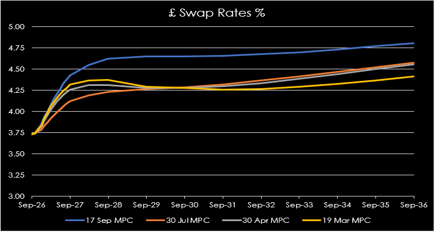
PegasusCapital - 18/09/2026
Whitepapers / Articles
A View from the Bridge - September 2026
PegasusCapital - 18/09/2026
